Hey, everyone!
I apologize for abandoning this blog. I've had quite a busy year, and have had no time to keep up with the pep talks every day. I will be leaving this up for the perusal and enjoyment of any NaNoer who needs it.
If you'd like to continue following me on my writing adventures, come over to my new blog. I chat about stuff besides writing.
I also published a book this August! You should buy it, because it's totally awesome!
Now that you've checked out my nifty links, get back to writing!
Saturday, November 1, 2014

Saturday, November 30, 2013
Finish Line!
Today is the day! Whether you’re writing that last scene, adding in song lyrics (alas, of this I am guilty), or taking out every contraction in order to reach that 50,000th word, today is the day you finish. You have trudged on when your character disobeyed, when you had a bad day, and even when you felt that there was no point in going on. But, you are here anyway!
*throws confetti*
If you are still behind, don’t give up until you reach midnight. Get where you can be alone and write until you can write no more. Your characters need an ending. You want to cross that finish line in the same manner as everyone else, arms raised high in exultation as you cross that ribbon? Then don’t quit!
Don’t look at the time, don’t look at your word count. Focus on your scene and write! When you’re finished, check the time and your word count. Set your alarm to go off ten minutes before midnight if you must.
Keep writing until you can write no more. Even if you fall short, you will know that you tried your best, and you still wrote more than you normally would have.
Once you are finished, rejoice. You made it! You wrote a book! It may not be the greatest masterpiece, but you finished it! You have now passed from the scores of people who have said, “I want to write a book someday” to the smaller crowd of “I’ve written a book! And I did it in 30 days!”
Take the next week off from writing. Enjoy the fact that you’re done. Partake of your reward and reintroduce yourself to your family. Get caught up on what you missed while you were writing.
I’ll be updating next week with some thoughts about what to do with your draft. Until then, friends, thank you so much for reading! I hope this has been an encouraging stop throughout your days. I am honored to have had some small part in your writing journey.
*throws confetti*
If you are still behind, don’t give up until you reach midnight. Get where you can be alone and write until you can write no more. Your characters need an ending. You want to cross that finish line in the same manner as everyone else, arms raised high in exultation as you cross that ribbon? Then don’t quit!
Don’t look at the time, don’t look at your word count. Focus on your scene and write! When you’re finished, check the time and your word count. Set your alarm to go off ten minutes before midnight if you must.
Keep writing until you can write no more. Even if you fall short, you will know that you tried your best, and you still wrote more than you normally would have.
Once you are finished, rejoice. You made it! You wrote a book! It may not be the greatest masterpiece, but you finished it! You have now passed from the scores of people who have said, “I want to write a book someday” to the smaller crowd of “I’ve written a book! And I did it in 30 days!”
Take the next week off from writing. Enjoy the fact that you’re done. Partake of your reward and reintroduce yourself to your family. Get caught up on what you missed while you were writing.
I’ll be updating next week with some thoughts about what to do with your draft. Until then, friends, thank you so much for reading! I hope this has been an encouraging stop throughout your days. I am honored to have had some small part in your writing journey.
Friday, November 29, 2013
The Ending
We are approaching the end of our writing journey. Our stories that were our new babies quickly turned into their terrible twos and began smashing everything in sight before we knew it. We kept on. The story settled down for a bit. We crossed hurdles. Your story kept adding pages, slowly but surely. And the character that has been behaving themselves suddenly turned into a rebellious teenager. “No, I don’t want to do that. I want to do this.”
Just when you felt like throttling said character, you found a solution that satisfied the both of you. And now, you are nearing the end of these character’s journeys. Some may die heroically. Some leave home happily, enjoying their new lives. Some may die of despair, letting the villain get away. Whatever your ending, it’s coming upon you. It is time for you as the writer to prepare for your characters to graduate from your story. To those that live, they will go on with their new lives, changed. Their new lives may be the subject of another book (that’s usually how mine turn out), but they will have a life beyond this one story.
Graduations are joyous occasions, but also a bit sad for the parent. One chapter in your child’s life is ending. They are moving on to things that do not involve you.
Obviously, these books are not your children. You still hear them arguing in the next room right now, assuring your that all is well in your corner of the world. But on the same token, you have breathed life into a story. And while these characters are fictional and only live in your head, they have been a part of your life for the past month. They have become your children to an extent. Sadly, it is time to set up when you will say goodbye.
Your entire story has been building to this moment. Make it appropriate and special. Prepare your characters for what will happen. Reveal that news you’ve been holding on to for three days. Set the scene. Record the last moment. Do it right, whatever your ending is. Keep on going until you know you’re done. You will know when it is time to leave your characters. Until you reach that moment, stay with them. Stop focusing on your word count. Focus on your story.
The ending is the most important part. Keep writing until you’re satisfied. When you are done, rejoice! Then check your word count. :)
Just when you felt like throttling said character, you found a solution that satisfied the both of you. And now, you are nearing the end of these character’s journeys. Some may die heroically. Some leave home happily, enjoying their new lives. Some may die of despair, letting the villain get away. Whatever your ending, it’s coming upon you. It is time for you as the writer to prepare for your characters to graduate from your story. To those that live, they will go on with their new lives, changed. Their new lives may be the subject of another book (that’s usually how mine turn out), but they will have a life beyond this one story.
Graduations are joyous occasions, but also a bit sad for the parent. One chapter in your child’s life is ending. They are moving on to things that do not involve you.
Obviously, these books are not your children. You still hear them arguing in the next room right now, assuring your that all is well in your corner of the world. But on the same token, you have breathed life into a story. And while these characters are fictional and only live in your head, they have been a part of your life for the past month. They have become your children to an extent. Sadly, it is time to set up when you will say goodbye.
Your entire story has been building to this moment. Make it appropriate and special. Prepare your characters for what will happen. Reveal that news you’ve been holding on to for three days. Set the scene. Record the last moment. Do it right, whatever your ending is. Keep on going until you know you’re done. You will know when it is time to leave your characters. Until you reach that moment, stay with them. Stop focusing on your word count. Focus on your story.
The ending is the most important part. Keep writing until you’re satisfied. When you are done, rejoice! Then check your word count. :)
Thursday, November 28, 2013
Give Thanks
It’s Thanksgiving today in the US. While holidays can be stressful, they are also an enjoyable time usually spent with family or close friends. You may have memorable moments on days like today. You may have extra time to write (yeah!) or none at all (boo).
Your assignment on this day is to simply be thankful. What you choose to be thankful for is up to you. Find three things in your personal life for which you are grateful. Then pick three things related to your writing, preferably your story, for which you are very thankful. For instance, you could be grateful for the minor character a friend helped you name, you figured out the layout of that important location, and that the villain will die soon.
Regardless of how much time you spend writing today (Don’t quit!), be sure to spend some time with your family today, thank them for their indulgence in your craziness, and also thank your cook.
Now, as you finish that meal and the dishes are put away, look at the clock. Haven’t you had a nice day? How much time until you have to go to bed or leave for the store to get a deal? See if you can get in a few hundred more words. Pie is a great writing snack. ;)
Your assignment on this day is to simply be thankful. What you choose to be thankful for is up to you. Find three things in your personal life for which you are grateful. Then pick three things related to your writing, preferably your story, for which you are very thankful. For instance, you could be grateful for the minor character a friend helped you name, you figured out the layout of that important location, and that the villain will die soon.
Regardless of how much time you spend writing today (Don’t quit!), be sure to spend some time with your family today, thank them for their indulgence in your craziness, and also thank your cook.
Now, as you finish that meal and the dishes are put away, look at the clock. Haven’t you had a nice day? How much time until you have to go to bed or leave for the store to get a deal? See if you can get in a few hundred more words. Pie is a great writing snack. ;)
Wednesday, November 27, 2013
Exhaustion
Weary NaNo writers, today’s entry is for you. There are some days when you simply do NOT feel like writing. Yesterday’s writing session was long and tiring. You made progress, but you don’t feel like you’ve written enough to help. Regardless of that extra hour you carved out to help you catch up, you’re still behind. Many have already won, and you’re still struggling to make it through your current scene.
Take a Break
Though time is important, your sanity as a writer is also important. If you spend too much time writing, you will become convinced that your story is no good, everything you’ve written deserves to be thrown away, and you were never cut out to be a writer. You recognize those thoughts? So do I. Doubt runs rampant in the last few days of NaNo. You are a writer. You can do this. You will not quit, because your story needs an ending. You want to prove those people wrong who told you that you couldn’t do it, don’t you?
But in order to maintain that confidence, you need to step away from your story for a bit. Breathe. Focus on something else. Go clean something that you’ve been neglecting. You’d be amazed what even a short break will do for your state of mind.
Advice From Dory
I was encouraging a fellow Wrimo the other day, and I found myself quoting Dory from Finding Nemo. “Just keep swimming” was her mantra when she was lost in the Australian waters. Though Marlin was frustrated and had no idea where to go, Dory was right beside him, annoying him with her happy little song. Without Dory’s confidence, Marlin would have never found Nemo again.
So today, friends, no matter how discouraged you are, remember to keep swimming. Keep doing what you know to do. Regardless of how little you believe in your ability to cross the finish line, regardless of your plot-related roadblock or how far behind you are, just keep swimming.
See what happens when you keep on going. Unless you make it through this dip in the road, you will never know what could have taken place. Don’t give up! You’re close to the finish line! If you buckle down and go on despite your exhaustion, you'll make it!
Take a Break
Though time is important, your sanity as a writer is also important. If you spend too much time writing, you will become convinced that your story is no good, everything you’ve written deserves to be thrown away, and you were never cut out to be a writer. You recognize those thoughts? So do I. Doubt runs rampant in the last few days of NaNo. You are a writer. You can do this. You will not quit, because your story needs an ending. You want to prove those people wrong who told you that you couldn’t do it, don’t you?
But in order to maintain that confidence, you need to step away from your story for a bit. Breathe. Focus on something else. Go clean something that you’ve been neglecting. You’d be amazed what even a short break will do for your state of mind.
Advice From Dory
I was encouraging a fellow Wrimo the other day, and I found myself quoting Dory from Finding Nemo. “Just keep swimming” was her mantra when she was lost in the Australian waters. Though Marlin was frustrated and had no idea where to go, Dory was right beside him, annoying him with her happy little song. Without Dory’s confidence, Marlin would have never found Nemo again.
So today, friends, no matter how discouraged you are, remember to keep swimming. Keep doing what you know to do. Regardless of how little you believe in your ability to cross the finish line, regardless of your plot-related roadblock or how far behind you are, just keep swimming.
See what happens when you keep on going. Unless you make it through this dip in the road, you will never know what could have taken place. Don’t give up! You’re close to the finish line! If you buckle down and go on despite your exhaustion, you'll make it!
Tuesday, November 26, 2013
Marathon Finish
NaNo season will be over soon. You will either be disappointed that it’s over or vastly relieved.
Either way, today you need to keep writing. You are now in the home stretch – there is less than a week left to cross the finish line. Don’t panic at the scores of people who are zeroing in on their 100k+ goals. This is a marathon. As long as you cross the finish line, you will have won. It does not matter that you didn’t cross the finish line first. That wasn’t your goal. Your goal was to finish. Whether or not your story extends beyond the 50k mark, all I want you to do is focus on that marker. You can do this!
Marathon runners train for months in order to reach their goal. While you haven’t been training for months, you’ve spent the past 24 days with your story. No one knows your story better than you. No one is more qualified to finish this story than you.
If you’re focusing on all the others who have crossed that 50k mark, please remember that this is not a true race. The people who have crossed that line are now on the sidelines and cheering you on. While NaNo is a community challenge, it is first and foremost a personal challenge. If the others who are ahead of you are bothering you, forget about them. Focus on that ribbon strung across the finish line. That ribbon is there for you. Keep on writing and edge ever closer to that fancy ribbon. You can do this! Write!
Either way, today you need to keep writing. You are now in the home stretch – there is less than a week left to cross the finish line. Don’t panic at the scores of people who are zeroing in on their 100k+ goals. This is a marathon. As long as you cross the finish line, you will have won. It does not matter that you didn’t cross the finish line first. That wasn’t your goal. Your goal was to finish. Whether or not your story extends beyond the 50k mark, all I want you to do is focus on that marker. You can do this!
Marathon runners train for months in order to reach their goal. While you haven’t been training for months, you’ve spent the past 24 days with your story. No one knows your story better than you. No one is more qualified to finish this story than you.
If you’re focusing on all the others who have crossed that 50k mark, please remember that this is not a true race. The people who have crossed that line are now on the sidelines and cheering you on. While NaNo is a community challenge, it is first and foremost a personal challenge. If the others who are ahead of you are bothering you, forget about them. Focus on that ribbon strung across the finish line. That ribbon is there for you. Keep on writing and edge ever closer to that fancy ribbon. You can do this! Write!
Monday, November 25, 2013
Fish or Cut Bait
If you are still behind, this entry is for you. My friend, the time has come to make a decision. Do you want to continue? We have five days left in this challenge. That is plenty of time to catch up, provided you have at least 15,000 words. If you are under this threshold, but have a firm grasp on your story and are able to clear your schedule, go for it. If not, sadly, I think it is safe to say you will not cross the finish line. However, you can still write to your heart’s content and finish this story at a time that is a little less hectic for you.
Now, on to the rest of you who are woefully behind and wondering if you can make it. Where there’s a will, there’s a way. See if you can clear out some writing time. Stay up later. Put on your best writing music and write. You are on a deadline. That pretty finish line ribbon will be taken down soon. You can still finish after that time, of course, but the NaNo deadline is approaching. You have five days.
Can you do this? Absolutely. You can buckle down, drive out distractions, and type to your heart’s content. If you’re sorely lacking in words, stop using contractions. Remove dashes from words that should be strung together. If you’re running out of plot and still need words, include song lyrics. Include the artist name. Describe a new landscape or a new outfit.
Remember it’s okay to come back later and fix things. Your purpose this month is not to fix what you’ve written. Your purpose this month is to get it written. Get that story out of your head and onto the page. Worry about the things that don’t need to be there or the wrong choice of words later. Today, your goal is to write. I have not bugged you before now about getting ahead.
But as of today, you only have five days! You not only must write, but you must write more than your daily quota. You know your best day’s word count? Try to beat that today. You are close to the finish line! Don’t quit!
Now is a good time to remind you that NaNo’s word counter is different than yours. Sample what you have and see if their word counter puts you ahead or behind. Adjust accordingly.
That pretty finish line ribbon is still strung across the borders that mark your 50,000th word. That line is incredibly close. Keep going!
Now, on to the rest of you who are woefully behind and wondering if you can make it. Where there’s a will, there’s a way. See if you can clear out some writing time. Stay up later. Put on your best writing music and write. You are on a deadline. That pretty finish line ribbon will be taken down soon. You can still finish after that time, of course, but the NaNo deadline is approaching. You have five days.
Can you do this? Absolutely. You can buckle down, drive out distractions, and type to your heart’s content. If you’re sorely lacking in words, stop using contractions. Remove dashes from words that should be strung together. If you’re running out of plot and still need words, include song lyrics. Include the artist name. Describe a new landscape or a new outfit.
Remember it’s okay to come back later and fix things. Your purpose this month is not to fix what you’ve written. Your purpose this month is to get it written. Get that story out of your head and onto the page. Worry about the things that don’t need to be there or the wrong choice of words later. Today, your goal is to write. I have not bugged you before now about getting ahead.
But as of today, you only have five days! You not only must write, but you must write more than your daily quota. You know your best day’s word count? Try to beat that today. You are close to the finish line! Don’t quit!
Now is a good time to remind you that NaNo’s word counter is different than yours. Sample what you have and see if their word counter puts you ahead or behind. Adjust accordingly.
That pretty finish line ribbon is still strung across the borders that mark your 50,000th word. That line is incredibly close. Keep going!
Sunday, November 24, 2013
Getting Back in the Game
This year, I’ve enlisted some of my writing buddies to help me blog about the wonderful/frustrating experience that is NaNoWriMo. This is from Phil, a local Wrimo with an awesome sense of humor. Phil has an amazing habit of catching up and winning on the very last day of November. I've enlisted him to tell us how he does it.
Almost everyone who participates in
NaNoWriMo quickly realises that no matter how good their intentions, life gets
in the way and often they will get behind the word par. Throughout my numerous
attempts at NaNoWriMo, Camp NaNoWriMo and Script Frenzy, I have found myself
frequently and sometimes significantly far from goal with time running out and the
month drawing to a close.
NaNoWriMo is about having fun and getting
your ideas out of your head and onto paper. Not hitting the goal is far from
the end of the world, and in fact sometimes you would rather write something
well first go around rather than accepting the poor quality which usually comes
from pushing out so many words in such a short space of time. If you decide
that you do want to hit that target but are staring at the stats page and
seeing next year’s date as the estimate, then perhaps these ideas beneath will
help you bridge the gap between your word count and the daily par.
1.
Refuse to give up. Make sure
you have told everyone you know that you are attempting NaNoWriMo and give
people updates, whether they want those updates or not. (If you haven’t already
done this yet this year, take a second before reading on to announce to the
word on Facebook or Twitter or whatever that you are doing it. Once you have
done this you may continue reading) After a while they will be keen to ask you
about it and this keeps you honest. Once people are asking you about your novel
it becomes harder to find ways to avoid writing – people are invested in your
success now, how could you possibly let them down?
2.
I’ve heard it said that
professional writers should get into a routine. Set aside the same part of the
day, every day, to write. That is all well and good for professional writers,
but us mere mortals rarely have that luxury. If you have fallen behind then you
need to start squeezing every drop of time out of your day to get back on
track. Sneak a couple of hundred words in on your breaks at work, sneak a
couple more in before dinner and then again before bed.
3.
If you find yourself behind
then you may need to get creative – have one of your minor characters suddenly
go on a three thousand word feminist rant (done that), refer to everyone by
their full names and titles (done that), switch perspective utterly to a new
character with an entirely different set of problems and people with whom they
can interact (did that this year). Writing is the goal – you can smooth out the
kinks in December. Just sit down somewhere, anywhere, and write.
4.
Try to find one day before the
end of the month that can be your ‘Big Catchy Uppy Day’. Try to get somewhere
comfy and just write. Set yourself small targets throughout the day and give
yourself rewards – I find candy to be effective. Do little sprints, 15-30
minutes at most. When you break the day down it becomes a lot easier and less
daunting. I have managed a ten thousand word day a few times, once out of
absolute necessity. On that day, I did not focus on how much I needed to write
still, but rather just focused on one little chunk, and when that was done I
moved onto the next chunk, completing the day in several small bursts of
literary enthusiasm.
5.
When times get tough and you
need to get back on track, call on your friends to help bail you out of the
hole. I am very fortunate to be married to our ML. She helped me overcome a
huge deficit in 2012. On November 21st I was over ten thousand words
behind schedule, with just twenty six and a half thousand words written. Over
the next nine days, and with fantastic support from those around me, I achieved
my goal and hit the 50k mark at around 11:50 on November 30th.
If I can do it, so can you!
Phil
Cumming is an absolute goof ball and routinely gets himself hideously behind on
his word count. He has the distinct pleasure of being married to the
Greenville, NC region’s ML and believes that everyone would benefit from living
with one, should they get the chance. Phil is participating in his fourth
NaNoWriMo event this November, having also successfully written for Script
Frenzy one year and Camp NaNoWriMo another. So far, he
has miraculously won on every occasion except the time he broke his wrist. He
feels he should have a ‘Get Out Of Jail Free’ card for that one.
Saturday, November 23, 2013
Stop Procrastinating
When I don’t want to do something, I find myself massively productive in other areas. If I’m avoiding a task, I check in on Facebook to update my friends on my word count. I decide to do the dishes or even get inspired to cook. Why? I don’t want to do what I need to do.
Breaks Are Important
Never let anyone tell you that breaks are pointless in writing. Can you imagine sitting at your computer from sunup to sundown until you finished writing your 50,000th word? I’d go nuts, too.
Breaks give you perspective. They let you focus your mind elsewhere. They help you tackle your next paragraph efficiently. Breaks are a wonderful tool, but we must use them wisely this month. We can’t write our stories if we spend more time on the internet than writing our stories.
Just Do It
Set a goal. Get to the end of the page. Write a new chapter. Finish the conversation. Finish the scene. Introduce the new character. Get to a point where you feel comfortable stopping, then take a break. Time yourself, or at least keep an eye on the time. If you’re not done for the day (you’ll know if you are), then remind yourself that you have to get back to writing.
Have you missed a TV show that you love? Promise yourself that you can watch the episode once you meet your word count goal. Find something simple that you can reward yourself with for reaching your goal. Let it become normal to sit at your computer and write.
Find something that works for you. Push yourself to get it done. Now, not tomorrow. Do you want to scramble to write 5000 words on the last day? Good. Then write. Now!
Breaks Are Important
Never let anyone tell you that breaks are pointless in writing. Can you imagine sitting at your computer from sunup to sundown until you finished writing your 50,000th word? I’d go nuts, too.
Breaks give you perspective. They let you focus your mind elsewhere. They help you tackle your next paragraph efficiently. Breaks are a wonderful tool, but we must use them wisely this month. We can’t write our stories if we spend more time on the internet than writing our stories.
Just Do It
Set a goal. Get to the end of the page. Write a new chapter. Finish the conversation. Finish the scene. Introduce the new character. Get to a point where you feel comfortable stopping, then take a break. Time yourself, or at least keep an eye on the time. If you’re not done for the day (you’ll know if you are), then remind yourself that you have to get back to writing.
Have you missed a TV show that you love? Promise yourself that you can watch the episode once you meet your word count goal. Find something simple that you can reward yourself with for reaching your goal. Let it become normal to sit at your computer and write.
Find something that works for you. Push yourself to get it done. Now, not tomorrow. Do you want to scramble to write 5000 words on the last day? Good. Then write. Now!
Friday, November 22, 2013
Dungeons
I’ll never forget the day I tossed my princess character into the dungeons. The first chapter chronicling the change went really well. I thought the next few chapters following her would be easy to write. WRONG.
In order to correctly portray my character, I had to put myself in her shoes as she cowered in fear in the dungeons. As a result, I hated the dungeon scenes. I was eager to leave, just like my princess.
When I revisited the story (after NaNo), I was forced to do a partial rewrite – adding in more dungeon scenes. I hated revisiting the dark and depressing part of my story. But because I did that, the story blossomed.
I said all that to tell you to trust your writing instincts. Trust me, you have them. If the story tells you to go to a dark place (provided it fits within your concept), you need to go there. You may not know why you’re going there. You may hate every moment of your dark place, but you still need to go there. Your character will grow. Growth leads to change. And change means the end of your story is approaching.
One day when you read over your story, you may discover your favorite place to read is the same scene that you didn’t want to write. Don’t be afraid to head to the dungeons. Just remember to bring a flashlight, so you can find your way out if you get lost.
In order to correctly portray my character, I had to put myself in her shoes as she cowered in fear in the dungeons. As a result, I hated the dungeon scenes. I was eager to leave, just like my princess.
When I revisited the story (after NaNo), I was forced to do a partial rewrite – adding in more dungeon scenes. I hated revisiting the dark and depressing part of my story. But because I did that, the story blossomed.
I said all that to tell you to trust your writing instincts. Trust me, you have them. If the story tells you to go to a dark place (provided it fits within your concept), you need to go there. You may not know why you’re going there. You may hate every moment of your dark place, but you still need to go there. Your character will grow. Growth leads to change. And change means the end of your story is approaching.
One day when you read over your story, you may discover your favorite place to read is the same scene that you didn’t want to write. Don’t be afraid to head to the dungeons. Just remember to bring a flashlight, so you can find your way out if you get lost.
Thursday, November 21, 2013
Viking Hats
If you live near my town, you might see something strange over the next few weeks. Our group has adopted a Viking theme. To celebrate this theme, we have each been given a Viking shield, a treasured colored marble, and a Viking hat.
Whenever we are working on our stories, we are encouraged to wear our hats. If you see someone with this hat, don’t be alarmed. It is a sign of a writer hard at work. Yes, we are just a little strange. We know that.
Respect the Vikings, or you may end up as a dead character in our stories. ;)


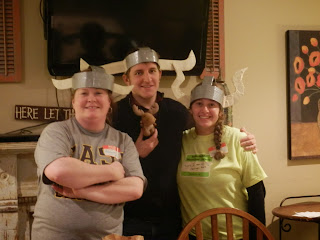

Whenever we are working on our stories, we are encouraged to wear our hats. If you see someone with this hat, don’t be alarmed. It is a sign of a writer hard at work. Yes, we are just a little strange. We know that.
Respect the Vikings, or you may end up as a dead character in our stories. ;)


Wednesday, November 20, 2013
I Can't
You’ve kicked Doubt out the door a number of times in the past several days, I see. Good job. But he always keeps crawling back in. Sneaky little thing. Kick him out again. Doubt has no place in your draft.
If you need more encouragement today, take a moment to read this story from Chicken Soup for the Soul.
---
Donna's fourth-grade classroom looked like many others I had seen in the past. Students sat in five rows of six desks. The teacher's desk was in the front and faced the students. The bulletin board featured student work. In most respects it appeared to be a typically traditional elementary classroom. Yet something seemed different that day I entered it for the first time. There seemed to be an undercurrent of excitement.
Donna was a veteran small-town Michigan schoolteacher only two years away from retirement. In addition she was a volunteer participant in a county-wide staff development project I had organized and facilitated. The training focused on language arts ideas that would empower students to feel good about themselves and take charge of their lives. Donna's job was to attend training sessions and implement the concepts being presented. My job was to make classroom visitations and encourage implementation.
I took an empty seat in the back of the room and watched. All the students were working on a task, filling a sheet of notebook paper with thoughts and ideas. The ten-year-old student closest to me was filling her page with "I Can'ts."
"I can't kick the soccer ball past second base."
"I can't do long division with more than three numerals."
"I can't get Debbie to like me."
Her page was half full and she showed no signs of letting up. She worked on with determination and persistence.
I walked down the row glancing at students' papers. Everyone was writing sentences, describing things they couldn't do.
"I can't do ten push-ups."
"I can't hit one over the left-field fence."
"I can't eat only one cookie."
By this time, the activity engaged my curiosity, so I decided to check with the teacher to see what was going on. As I approached her, I noticed that she too was busy writing. I felt it best not to interrupt.
"I can't get John's mother to come in for a teacher conference."
"I can't get my daughter to put gas in the car."
"I can't get Alan to use words instead of fists."
Thwarted in my efforts to determine why students and teacher were dwelling on the negative instead of writing the more positive "I Can" statements, I returned to my seat and continued my observations. Students wrote for another ten minutes. Most filled their page. Some started another.
"Finish the one you're on and don't start a new one," were the instructions Donna used to signal the end of the activity. Students were then instructed to fold their papers in half and bring them to the front. When students reached the teacher's desk, they placed their "I Can't" statements into an empty shoe box.
When all of the student papers were collected, Donna added hers. She put the lid on the box, tucked it under her arm and headed out the door and down the hall. Students followed the teacher. I followed the students.
Halfway down the hall the procession stopped. Donna entered the custodian's room, rummaged around and came out with a shovel. Shovel in one hand, shoe box in the other, Donna marched the students out of the school to the farthest corner of the playground. There they began to dig.
They were going to bury their "I Can'ts"! The digging took over ten minutes because most of the fourth-graders wanted a turn. When the hole approached three-feet deep, the digging ended. The box of "I Can'ts" was placed in position at the bottom of the hole and quickly covered with dirt.
Thirty-one 10- and 11-year-olds stood around the freshly dug grave site. Each had at least one page full of "I Can'ts" in the shoe box, four-feet under. So did their teacher.
At this point Donna announced, "Boys and girls, please join hands and bow your heads." The students complied. They quickly formed a circle around the grave, creating a bond with their hands. They lowered their heads and waited. Donna delivered the eulogy.
"Friends, we gather today to honor the memory of 'I Can't.' While he was with us on earth, he touched the lives of everyone, some more than others. His name, unfortunately, has been spoken in every public building—schools, city halls, state capitols and yes, even The White House.
"We have provided 'I Can't' with a final resting place and a headstone that contains his epitaph. He is survived by his brothers and sister 'I Can', 'I Will' and 'I'm Going to Right Away.' They are not as well known as their famous relative and are certainly not as strong and powerful yet. Perhaps some day, with your help, they will make an even bigger mark on the world.
"May ‘I Can't’ rest in peace and may everyone present pick up their lives and move forward in his absence. Amen."
As I listened to the eulogy I realized that these students would never forget this day. The activity was symbolic, a metaphor for life. It was a right-brain experience that would stick in the unconscious and conscious mind forever. Writing "I Can'ts," burying them and hearing the eulogy. That was a major effort on the part of this teacher. And she wasn't done yet. At the conclusion of the eulogy she turned the students around, marched them back into the classroom and held a wake.
They celebrated the passing of "I Can't" with cookies, popcorn and fruit juices. As part of the celebration, Donna cut out a large tombstone from butcher paper. She wrote the words "I Can't" at the top and put RIP in the middle. The date was added at the bottom.
The paper tombstone hung in Donna's classroom for the remainder of the year. On those rare occasions when a student forgot and said, "I Can't," Donna simply pointed to the RIP sign. The student then remembered that "I Can't" was dead and chose to rephrase the statement.
I wasn't one of Donna's students. She was one of mine. Yet that day I learned an enduring lesson from her. Now, years later, whenever I hear the phrase, "I Can't," I see images of that fourth-grade funeral. Like the students, I remember that "I Can't" is dead.
Chick Moorman
If you need more encouragement today, take a moment to read this story from Chicken Soup for the Soul.
---
Donna's fourth-grade classroom looked like many others I had seen in the past. Students sat in five rows of six desks. The teacher's desk was in the front and faced the students. The bulletin board featured student work. In most respects it appeared to be a typically traditional elementary classroom. Yet something seemed different that day I entered it for the first time. There seemed to be an undercurrent of excitement.
Donna was a veteran small-town Michigan schoolteacher only two years away from retirement. In addition she was a volunteer participant in a county-wide staff development project I had organized and facilitated. The training focused on language arts ideas that would empower students to feel good about themselves and take charge of their lives. Donna's job was to attend training sessions and implement the concepts being presented. My job was to make classroom visitations and encourage implementation.
I took an empty seat in the back of the room and watched. All the students were working on a task, filling a sheet of notebook paper with thoughts and ideas. The ten-year-old student closest to me was filling her page with "I Can'ts."
"I can't kick the soccer ball past second base."
"I can't do long division with more than three numerals."
"I can't get Debbie to like me."
Her page was half full and she showed no signs of letting up. She worked on with determination and persistence.
I walked down the row glancing at students' papers. Everyone was writing sentences, describing things they couldn't do.
"I can't do ten push-ups."
"I can't hit one over the left-field fence."
"I can't eat only one cookie."
By this time, the activity engaged my curiosity, so I decided to check with the teacher to see what was going on. As I approached her, I noticed that she too was busy writing. I felt it best not to interrupt.
"I can't get John's mother to come in for a teacher conference."
"I can't get my daughter to put gas in the car."
"I can't get Alan to use words instead of fists."
Thwarted in my efforts to determine why students and teacher were dwelling on the negative instead of writing the more positive "I Can" statements, I returned to my seat and continued my observations. Students wrote for another ten minutes. Most filled their page. Some started another.
"Finish the one you're on and don't start a new one," were the instructions Donna used to signal the end of the activity. Students were then instructed to fold their papers in half and bring them to the front. When students reached the teacher's desk, they placed their "I Can't" statements into an empty shoe box.
When all of the student papers were collected, Donna added hers. She put the lid on the box, tucked it under her arm and headed out the door and down the hall. Students followed the teacher. I followed the students.
Halfway down the hall the procession stopped. Donna entered the custodian's room, rummaged around and came out with a shovel. Shovel in one hand, shoe box in the other, Donna marched the students out of the school to the farthest corner of the playground. There they began to dig.
They were going to bury their "I Can'ts"! The digging took over ten minutes because most of the fourth-graders wanted a turn. When the hole approached three-feet deep, the digging ended. The box of "I Can'ts" was placed in position at the bottom of the hole and quickly covered with dirt.
Thirty-one 10- and 11-year-olds stood around the freshly dug grave site. Each had at least one page full of "I Can'ts" in the shoe box, four-feet under. So did their teacher.
At this point Donna announced, "Boys and girls, please join hands and bow your heads." The students complied. They quickly formed a circle around the grave, creating a bond with their hands. They lowered their heads and waited. Donna delivered the eulogy.
"Friends, we gather today to honor the memory of 'I Can't.' While he was with us on earth, he touched the lives of everyone, some more than others. His name, unfortunately, has been spoken in every public building—schools, city halls, state capitols and yes, even The White House.
"We have provided 'I Can't' with a final resting place and a headstone that contains his epitaph. He is survived by his brothers and sister 'I Can', 'I Will' and 'I'm Going to Right Away.' They are not as well known as their famous relative and are certainly not as strong and powerful yet. Perhaps some day, with your help, they will make an even bigger mark on the world.
"May ‘I Can't’ rest in peace and may everyone present pick up their lives and move forward in his absence. Amen."
As I listened to the eulogy I realized that these students would never forget this day. The activity was symbolic, a metaphor for life. It was a right-brain experience that would stick in the unconscious and conscious mind forever. Writing "I Can'ts," burying them and hearing the eulogy. That was a major effort on the part of this teacher. And she wasn't done yet. At the conclusion of the eulogy she turned the students around, marched them back into the classroom and held a wake.
They celebrated the passing of "I Can't" with cookies, popcorn and fruit juices. As part of the celebration, Donna cut out a large tombstone from butcher paper. She wrote the words "I Can't" at the top and put RIP in the middle. The date was added at the bottom.
The paper tombstone hung in Donna's classroom for the remainder of the year. On those rare occasions when a student forgot and said, "I Can't," Donna simply pointed to the RIP sign. The student then remembered that "I Can't" was dead and chose to rephrase the statement.
I wasn't one of Donna's students. She was one of mine. Yet that day I learned an enduring lesson from her. Now, years later, whenever I hear the phrase, "I Can't," I see images of that fourth-grade funeral. Like the students, I remember that "I Can't" is dead.
Chick Moorman
Tuesday, November 19, 2013
Plan Your Vacation Now
Now that you’re settled into a routine of some sort involving your writing, I want you to look ahead. Take a look at your calendar and run through what you have scheduled in the next few weeks. Yup. Thanksgiving is approaching. This could mean you will not be writing that day because you’re cooking the meal, or you’re getting up at 5am, putting the turkey in the oven, and using the extra hours when you could be sleeping to write more in your story.
Whether or not your Thanksgiving plans will impact your writing goals, I want you to use this time to think ahead. Yes, November will end and you will not need to write for a while. But I want you to pick a date in November as your vacation day.
On this day, you will not write. You can focus on your neglected chores, pets, and family. You can take time to watch the program you’ve been recording the past few weeks. You can remind yourself what December feels like.
Have you found a date that you want to spend off the computer? Good.
Keep Writing
Now that you have a goal in mind, it is your job to get ahead. In order to use this date as your vacation, you must have an extra word cushion. This will enable you to not only enjoy your vacation, but not stress about your story. Okay, at least not stress about your story as you’re writing it. If you create one day’s quota worth of cushion, you can skip a day and come back the next time refreshed.
Why?
Breaks give you perspective. I have always taken at least one day off from my book during the month of November. My birthday is always around Thanksgiving, so I use one of those two days to relax and be with my family.
One year, my older brother came to visit for Thanksgiving. I wrote that morning. I was excited, because I was nearing the end of the story. But when he came, I finished my thought, saved the program, and put up my laptop. I did not write for the rest of the day.
For the record, when you’re that close to the end, it’s really hard to stop. But I did it because I wanted to spend time with my brother instead of enjoying the fact that he was in the room while simultaneously ignoring him. Looking back, I’m glad I stopped. I thought I would finish that day. I didn’t. I had about another three chapters to go. I would have spent all day obsessing about nearing the end instead of enjoying the holiday with my family.
Keep Your Vacation in Mind
When you’re getting frustrated with your story and its lack of progress, look back at the calendar. You don’t have to wait until December to lay the story aside. Your vacation is coming up. But in order to enjoy it, you have to keep writing. Give yourself other things you can do on your vacation day if you reach this amount of words by a certain date or time. See what happens.
Giving yourself challenges and then rewarding yourself for meeting them is very satisfying. That is part of the reason the NaNoWriMo challenge works so well.
Whether or not your Thanksgiving plans will impact your writing goals, I want you to use this time to think ahead. Yes, November will end and you will not need to write for a while. But I want you to pick a date in November as your vacation day.
On this day, you will not write. You can focus on your neglected chores, pets, and family. You can take time to watch the program you’ve been recording the past few weeks. You can remind yourself what December feels like.
Have you found a date that you want to spend off the computer? Good.
Keep Writing
Now that you have a goal in mind, it is your job to get ahead. In order to use this date as your vacation, you must have an extra word cushion. This will enable you to not only enjoy your vacation, but not stress about your story. Okay, at least not stress about your story as you’re writing it. If you create one day’s quota worth of cushion, you can skip a day and come back the next time refreshed.
Why?
Breaks give you perspective. I have always taken at least one day off from my book during the month of November. My birthday is always around Thanksgiving, so I use one of those two days to relax and be with my family.
One year, my older brother came to visit for Thanksgiving. I wrote that morning. I was excited, because I was nearing the end of the story. But when he came, I finished my thought, saved the program, and put up my laptop. I did not write for the rest of the day.
For the record, when you’re that close to the end, it’s really hard to stop. But I did it because I wanted to spend time with my brother instead of enjoying the fact that he was in the room while simultaneously ignoring him. Looking back, I’m glad I stopped. I thought I would finish that day. I didn’t. I had about another three chapters to go. I would have spent all day obsessing about nearing the end instead of enjoying the holiday with my family.
Keep Your Vacation in Mind
When you’re getting frustrated with your story and its lack of progress, look back at the calendar. You don’t have to wait until December to lay the story aside. Your vacation is coming up. But in order to enjoy it, you have to keep writing. Give yourself other things you can do on your vacation day if you reach this amount of words by a certain date or time. See what happens.
Giving yourself challenges and then rewarding yourself for meeting them is very satisfying. That is part of the reason the NaNoWriMo challenge works so well.
Monday, November 18, 2013
Silence
Some of my scattered thoughts on a wonderful rarity in November, silence. This was written during a planning session for NaNoWriMo.
I’m sitting in our usual NaNo gathering spot with yet another group of local writers. As of this writing, NaNoWriMo is less than a month away. My local group has gathered to plan.
I should be planning something on my actual NaNo story, finishing up the other story that I haven’t finished yet, or planning a blog entry actually relating to writing and how to do it quickly. What am I doing instead? Writing a blog entry about silence.
The group has introduced ourselves and our stories more than once as people kept joining us. After the last round of introductions and story summaries, one writer sarcastically held up his hand and went, “Three, two, one, plan!”
That was all it took. It has been nearly half an hour of silence in our room. Each writer is focused on their book and furiously making notes. I’m the only one slacking off right now.
I should be taking advantage of the silence. I cherish writing in quiet places. Some people prefer white noise. I write better without it.
I love write-ins, but I usually get more written at home. The people who talk during our meetings distract me. But I’m usually not worried about reaching the finish line, so I’ve never cared.
Well, I’ve jotted down some thoughts about silence. It does happen during these meetings, but it certainly is rare. Silence has come of its own accord. Am I using it? No.
I should fix that. Bye!
I’m sitting in our usual NaNo gathering spot with yet another group of local writers. As of this writing, NaNoWriMo is less than a month away. My local group has gathered to plan.
I should be planning something on my actual NaNo story, finishing up the other story that I haven’t finished yet, or planning a blog entry actually relating to writing and how to do it quickly. What am I doing instead? Writing a blog entry about silence.
The group has introduced ourselves and our stories more than once as people kept joining us. After the last round of introductions and story summaries, one writer sarcastically held up his hand and went, “Three, two, one, plan!”
That was all it took. It has been nearly half an hour of silence in our room. Each writer is focused on their book and furiously making notes. I’m the only one slacking off right now.
I should be taking advantage of the silence. I cherish writing in quiet places. Some people prefer white noise. I write better without it.
I love write-ins, but I usually get more written at home. The people who talk during our meetings distract me. But I’m usually not worried about reaching the finish line, so I’ve never cared.
Well, I’ve jotted down some thoughts about silence. It does happen during these meetings, but it certainly is rare. Silence has come of its own accord. Am I using it? No.
I should fix that. Bye!
Sunday, November 17, 2013
Why Am I Doing This?
This year, I’ve enlisted some of my writing buddies to help me blog about the wonderful/frustrating experience that is NaNoWriMo. This is Mandy, a Wrimo I met three years ago. She has since become our wonderful Municipal Liason. That's NaNo speak for saying she's an awesome volunteer who runs all our meetings.
There are many answers as to why one should participate in National Novel Writing Month. Some people do it because they have always wanted to write a novel, stumbled upon this website that offers a free challenge with tons of support and decided to go for it. Some people are seasoned writers using the November challenge to push themselves. Others just love the thrill of the insane deadline. But I think nearly all NaNoWriMo participants do it for a second reason: because it is FUN.
There will probably times this month where you will wonder why you are even doing this. You may be behind on word count, your characters are dragging their feet and refuse to do what you ask them to do, and your saving grace (the coffee pot) might have stopped working on you. Whenever you are in a slump and you don't know what to write and you feel like you'll never catch up and you're completely stuck, remember why you are doing this. You are doing this to have fun! Pick yourself up, dust off your knees and make something crazy happen in your story!
Do something fun and unexpected, even if it makes absolutely no sense to your plot! One of the worst things you can do for your novel is to stop writing it. So push through the blocks by adding ninjas, or pirates. Introduce a crazy uncle with Tourettes who makes everyone uncomfortable, or have your characters attacked by a swarm of zombified birds. Do whatever it takes to keep your story alive! Hopefully, whatever outrageous thing you add will eventually bring your characters out of the darkness and into the light of a flowing scene. Plus, putting characters through insane situations might cause you to learn something about them that you didn't know before!
It's very important that you don't worry about what other people might think or say about your novel in its current state. Don't discount your ideas just because you think other people might not like them, or might find stupid. Most ideas are worth trying out at least once! Remember: December is National Novel Editing Month. That's when you can edit out the parts with the ninjas and the crazy birds. You might be surprised with what you have left. You might be even more surprised that the story works with zombie birds. The point of NaNoWriMo, ultimately, is that you write. And that you have fun while you are writing. Maybe by the end of November you won't have the Next Great American Novel. But you will have 50,000 words that you wrote, and you will have had fun writing them!
This is Mandy's fourth attempt at NaNoWriMo. She has won three years previously, twice with a final word count of 100k. She is currently a student at Pitt Community College and hopes to obtain a bachelor degree in Zoology from NC State. She dreams of one day becoming a children's book author and illustrator, as well as a wildlife rehabilitator. She has trained for two marathons and ran one last October. She lives with her husband, dog, eleven cats, and a marsupial out on the bleak and rugged tundra of the North Pole. She also owns and runs an Etsy shop in which she sells a variety of handmade woodland-creature-related gifts. Check it out here.
Saturday, November 16, 2013
What If It's No Good?
So, you’ve reached the point in the story where you’ve met your characters, set the scene, and the conflict has been introduced. And while you’re probably really excited about your story, you’re wondering at the same time if it’s any good. The coworkers, friends, and relatives you regale with your last impressive dialogue bit just smile politely at you instead of agreeing that you are, in fact, brilliant. If you’ve happened to reread what you’ve written (some do, some don’t), you might be panicked because the scenes that seemed awesome three days ago now seem bland. The doubt that always plagues a writer now seems more credible than ever. You wonder in the back of your mind constantly, what if it’s no good?
Don’t Judge It Now
Any new story will seem awesome, brilliant, and perfect to you. Maybe not to the rest of the world, but to you at least. That is okay. New stories are good things for writers, even if we are the only ones to ever read them.
It will take time, hard work, and dedication to complete your book. The writing process is a very challenging, frustrating, and irritating experience. It can also be fun and rewarding. One day, a few months from now, you will open up your completed document and look over the little manuscript you chose to create in a moment that you later described as insanity. No matter how bad your book may be, I have found it is still rewarding to see what you have written.
What I’ve discovered is you can’t judge a new story as it is still taking shape. You don’t know if it will be brilliant or not until after you’ve completed it. Even then, it will likely be a month or two before you can look back at your book and make any kind of sound judgment on story. You may choose to clean up your mess and move on toward publishing. You may decide it is a piece of trash. Either way, it is okay. You have completed a book, and you have won.
You Have Not Failed
Even if you decide after rereading your manuscript that the book is no good and deserves to be deleted from existence, it is okay. You have not wasted the days you spent slaving over a keyboard, pouring your heart and soul into a story that you now hate. If you reach the conclusion at some point in the future that this story needs to be erased or just dropped, it is fine.
You will have gained experience from such a book. You have learned how to complete a book without your head exploding. You have learned to manage your life and complete a work of art. Not every artist paints something worthy of being shown in a museum, right? You will have learned something from the time it took to complete your book, and you can apply it to your next writing venture.
Believe In Yourself
Let’s head to that unfinished manuscript. You’re wondering whether or not it’s any good. Sadly, you won’t know for a while whether or not the story you’ve created is good enough to entertain anyone beyond you or people who know you. But that’s not important right now. What you have to do is set those details aside. Set your doubts aside. Believe in yourself.
Time will tell whether or not the manuscript you’re slowly but surely cranking out is the Next Great American Novel. You don’t know anything for certain right now, so we will just imagine that it is so. On the days when Doubt is whispering, “This is crazy! You can’t do this! This book isn’t even that good! You should quit!” just ignore it.
Imagine instead that you’re writing the next bestseller series, like Twilight or the Hunger Games (If nothing else, respect their success). What if you’re writing an awesome story that has the potential to make millions? How would you feel if you never finished it? What if writing is your calling, and you’ll never know it unless you finish this book? How will those following your progress on the story feel if they hear you want to give up?
Sure, you may not be writing the next bestseller. You may not make millions of dollars. You may end up trashing the whole book and being glad about it. But you don’t know anything yet, because the story isn’t finished. You haven’t given yourself time to find out if the novel is any good. Don’t sell yourself short. For just a moment, believe in yourself. Believe that this story has the potential to reach millions of readers. And each of those readers want to make you rich.
Now start writing that next scene. One day, we’ll find out if you’re right when you daydream about success. But not until you finish.
Don’t Judge It Now
Any new story will seem awesome, brilliant, and perfect to you. Maybe not to the rest of the world, but to you at least. That is okay. New stories are good things for writers, even if we are the only ones to ever read them.
It will take time, hard work, and dedication to complete your book. The writing process is a very challenging, frustrating, and irritating experience. It can also be fun and rewarding. One day, a few months from now, you will open up your completed document and look over the little manuscript you chose to create in a moment that you later described as insanity. No matter how bad your book may be, I have found it is still rewarding to see what you have written.
What I’ve discovered is you can’t judge a new story as it is still taking shape. You don’t know if it will be brilliant or not until after you’ve completed it. Even then, it will likely be a month or two before you can look back at your book and make any kind of sound judgment on story. You may choose to clean up your mess and move on toward publishing. You may decide it is a piece of trash. Either way, it is okay. You have completed a book, and you have won.
You Have Not Failed
Even if you decide after rereading your manuscript that the book is no good and deserves to be deleted from existence, it is okay. You have not wasted the days you spent slaving over a keyboard, pouring your heart and soul into a story that you now hate. If you reach the conclusion at some point in the future that this story needs to be erased or just dropped, it is fine.
You will have gained experience from such a book. You have learned how to complete a book without your head exploding. You have learned to manage your life and complete a work of art. Not every artist paints something worthy of being shown in a museum, right? You will have learned something from the time it took to complete your book, and you can apply it to your next writing venture.
Believe In Yourself
Let’s head to that unfinished manuscript. You’re wondering whether or not it’s any good. Sadly, you won’t know for a while whether or not the story you’ve created is good enough to entertain anyone beyond you or people who know you. But that’s not important right now. What you have to do is set those details aside. Set your doubts aside. Believe in yourself.
Time will tell whether or not the manuscript you’re slowly but surely cranking out is the Next Great American Novel. You don’t know anything for certain right now, so we will just imagine that it is so. On the days when Doubt is whispering, “This is crazy! You can’t do this! This book isn’t even that good! You should quit!” just ignore it.
Imagine instead that you’re writing the next bestseller series, like Twilight or the Hunger Games (If nothing else, respect their success). What if you’re writing an awesome story that has the potential to make millions? How would you feel if you never finished it? What if writing is your calling, and you’ll never know it unless you finish this book? How will those following your progress on the story feel if they hear you want to give up?
Sure, you may not be writing the next bestseller. You may not make millions of dollars. You may end up trashing the whole book and being glad about it. But you don’t know anything yet, because the story isn’t finished. You haven’t given yourself time to find out if the novel is any good. Don’t sell yourself short. For just a moment, believe in yourself. Believe that this story has the potential to reach millions of readers. And each of those readers want to make you rich.
Now start writing that next scene. One day, we’ll find out if you’re right when you daydream about success. But not until you finish.
Friday, November 15, 2013
Plan Your Reward
Take a moment to celebrate. Today is the halfway mark of NaNo! Woohoo! You should break 25k in your story today. Now, if you aren’t there yet, please do not panic. There is still plenty of time to catch up.
With the finish line finally visible in the distant horizon, today I will give you another strategy to help you keep going, despite the headaches your character is giving you. Today, I want you to think about the first of December. Your writing vacation will begin. Your local region will likely host a TGIO party, celebrating the end of NaNoWriMo and everyone’s successes. In December, you can focus on your family again, start planning holiday things, and enjoy your free evenings.
Now, to help motivate you further to finish your story, I want you to plan a reward for yourself. It does not have to be expensive. It does not have to be done alone. But I want you to promise yourself a treat when you finish your story. Regardless of your views on your story, this reward will remind you that you have accomplished a tremendous feat. You wrote a book. That’s an awesome thing. Finishing is always fun. You deserve to relish your victory.
Go get a milkshake. Watch a movie. Take your family out to dinner. Cook for your family again. Get a haircut. Buy a new outfit. Buy a new Christmas decoration. Play that game you’ve been avoiding the past month.
Do you have an appropriate reward in mind? Good. Now get back to that story and break the 25k barrier! If you can cross this line, the rest of the writing journey on this draft will get a little easier. When you get discouraged, remind yourself of that reward. It should help you keep writing.
With the finish line finally visible in the distant horizon, today I will give you another strategy to help you keep going, despite the headaches your character is giving you. Today, I want you to think about the first of December. Your writing vacation will begin. Your local region will likely host a TGIO party, celebrating the end of NaNoWriMo and everyone’s successes. In December, you can focus on your family again, start planning holiday things, and enjoy your free evenings.
Now, to help motivate you further to finish your story, I want you to plan a reward for yourself. It does not have to be expensive. It does not have to be done alone. But I want you to promise yourself a treat when you finish your story. Regardless of your views on your story, this reward will remind you that you have accomplished a tremendous feat. You wrote a book. That’s an awesome thing. Finishing is always fun. You deserve to relish your victory.
Go get a milkshake. Watch a movie. Take your family out to dinner. Cook for your family again. Get a haircut. Buy a new outfit. Buy a new Christmas decoration. Play that game you’ve been avoiding the past month.
Do you have an appropriate reward in mind? Good. Now get back to that story and break the 25k barrier! If you can cross this line, the rest of the writing journey on this draft will get a little easier. When you get discouraged, remind yourself of that reward. It should help you keep writing.
Thursday, November 14, 2013
Push Yourself
I’ve been writing long enough to know how I operate. I know what will make me work harder. I know how to push myself to get something done. The thrill of finishing a book is amazing. My aim is to help you experience this feeling for yourself.
What Makes You Work Harder?
If you write better with music, turn it on. If you write better with white noise, find the loudest place in the house and get to work. If you will work extra hard to get a candy bar, set one out and get to work!
I do well rewarding myself for making certain goals. Last year, if I went 2k above my word goal, I could have a cream soda. I was out of cream soda very early on.
Find what works well for you. Reward yourself for writing. Don’t check the internet until you’ve made your quota. Don’t leave the noisy room until you’ve gotten caught up in your word count.
Why Bother?
As you’ve discovered by now, this is hard. Yes, you’re tired of doing it. Yes, I have questioned my sanity, too. But the point I want to drive home is that this is worth it. If you can write this story, you can do just about anything.
Now, get back to your story! Your character needs you to tell him what happens next.
What Makes You Work Harder?
If you write better with music, turn it on. If you write better with white noise, find the loudest place in the house and get to work. If you will work extra hard to get a candy bar, set one out and get to work!
I do well rewarding myself for making certain goals. Last year, if I went 2k above my word goal, I could have a cream soda. I was out of cream soda very early on.
Find what works well for you. Reward yourself for writing. Don’t check the internet until you’ve made your quota. Don’t leave the noisy room until you’ve gotten caught up in your word count.
Why Bother?
As you’ve discovered by now, this is hard. Yes, you’re tired of doing it. Yes, I have questioned my sanity, too. But the point I want to drive home is that this is worth it. If you can write this story, you can do just about anything.
Now, get back to your story! Your character needs you to tell him what happens next.
Wednesday, November 13, 2013
Practice Makes Perfect
The age old adage is true for just about anything new you’re learning to do. Playing the piano, driving a car, cooking, beating the last level of a video game – if you practice long enough, you will eventually be able to not only achieve your goal, but get the steps down to perfection.
With enough practice, you can play a song on the piano flawlessly. You can cook a meal without burning anything that also tastes good. You can drive a car without hitting anything (or scaring anyone). All it takes is practice, and you will eventually do it perfectly.
Alas, this is not true of writing. I don’t care if you’re Stephen King, J.K. Rowling, or Frank Peretti, you’re not going to write a perfect book your first time through. Even if you’ve written a hundred different books, even if you’ve been published many times, and even if you know the story you’re about to pen like the back of your hand – the first draft will not be perfect. Even the authors who write best sellers every time will not write perfect drafts.
Why?
There is no such thing as a perfect draft. A draft indicates it is not done. And even when you possess a full length manuscript, alas, that isn’t perfect, either.
For whatever reason, first drafts will be full of mistakes. Whether you’re the kind of writer that corrects typos as they go or saves them all for after the pressures of the novel are over, you will still have errors. There will be big errors (oops, I never mentioned that character again) and small errors (their, not there). And silly errors (whoops, I meant the home country there, not the enemy country). It happens. There will be time to fix your errors. Lots of time. Trust me.
But don’t worry about that now (unless you’re one of the writers who can’t go on unless you fix the error in your third paragraph. Then by all means, fix it). Your goal in writing this novel is not to achieve perfection.
This is not learning the piano, singing a song, riding a bike, cooking a meal, or driving a car. You are writing a book. There is nothing like it. No matter how many times you’ve done it before, you will always make some mistakes.
Well, What’s the Point?
The beauty of writing is that practice does help. You learn what not to do. You learn what works best for you. You learn what to do better. You remember to add details if you’re the kind of person that forgets them in the first draft.
Say it with me: Perfection is not the goal.
Finishing is our goal. Regardless of what your intentions are with your story (I have heard of some who burn the bad sections), your goal is to finish what you started. If things get to the point where you cannot meet your goal by the end of the month, that is fine. Set your story aside. But come back to it. I have favorite parts in all my novels, including the ones I have decided not to pursue publishing. Those stories helped me in other ways. I enjoy reading them. It was fun to do at the time.
But most importantly, the things those books taught me was how to write. I learned how to write a mystery when I didn’t know all the details of the crime. I learned how to write historical fiction by reading the Biblical account of the character I was following (and a whole lot of embellishing and making it up because I was too lazy to do research). Regardless, I learned from the venture.
Don’t beat yourself up that your story isn’t perfect. Perfection is not the goal. Accept that you are hammering out a draft. This draft will be made up only by long hours in front of your computer. It will take blood, sweat, and tears. It will take dedication. It will take time.
NaNoWriMo is not about creating a perfect book. It is about pulling a first draft out. It is about learning to create time to sit down and write. Chances are, if you can do it once, during one month, you will do it at other times as well.
Have you found one of those errors yet? Good. It is a sign that you are not perfect and you will never be perfect. However, with practice, your writing will get better. That, my friends, is our goal.
Now go, WRITE! (Win!)
With enough practice, you can play a song on the piano flawlessly. You can cook a meal without burning anything that also tastes good. You can drive a car without hitting anything (or scaring anyone). All it takes is practice, and you will eventually do it perfectly.
Alas, this is not true of writing. I don’t care if you’re Stephen King, J.K. Rowling, or Frank Peretti, you’re not going to write a perfect book your first time through. Even if you’ve written a hundred different books, even if you’ve been published many times, and even if you know the story you’re about to pen like the back of your hand – the first draft will not be perfect. Even the authors who write best sellers every time will not write perfect drafts.
Why?
There is no such thing as a perfect draft. A draft indicates it is not done. And even when you possess a full length manuscript, alas, that isn’t perfect, either.
For whatever reason, first drafts will be full of mistakes. Whether you’re the kind of writer that corrects typos as they go or saves them all for after the pressures of the novel are over, you will still have errors. There will be big errors (oops, I never mentioned that character again) and small errors (their, not there). And silly errors (whoops, I meant the home country there, not the enemy country). It happens. There will be time to fix your errors. Lots of time. Trust me.
But don’t worry about that now (unless you’re one of the writers who can’t go on unless you fix the error in your third paragraph. Then by all means, fix it). Your goal in writing this novel is not to achieve perfection.
This is not learning the piano, singing a song, riding a bike, cooking a meal, or driving a car. You are writing a book. There is nothing like it. No matter how many times you’ve done it before, you will always make some mistakes.
Well, What’s the Point?
The beauty of writing is that practice does help. You learn what not to do. You learn what works best for you. You learn what to do better. You remember to add details if you’re the kind of person that forgets them in the first draft.
Say it with me: Perfection is not the goal.
Finishing is our goal. Regardless of what your intentions are with your story (I have heard of some who burn the bad sections), your goal is to finish what you started. If things get to the point where you cannot meet your goal by the end of the month, that is fine. Set your story aside. But come back to it. I have favorite parts in all my novels, including the ones I have decided not to pursue publishing. Those stories helped me in other ways. I enjoy reading them. It was fun to do at the time.
But most importantly, the things those books taught me was how to write. I learned how to write a mystery when I didn’t know all the details of the crime. I learned how to write historical fiction by reading the Biblical account of the character I was following (and a whole lot of embellishing and making it up because I was too lazy to do research). Regardless, I learned from the venture.
Don’t beat yourself up that your story isn’t perfect. Perfection is not the goal. Accept that you are hammering out a draft. This draft will be made up only by long hours in front of your computer. It will take blood, sweat, and tears. It will take dedication. It will take time.
NaNoWriMo is not about creating a perfect book. It is about pulling a first draft out. It is about learning to create time to sit down and write. Chances are, if you can do it once, during one month, you will do it at other times as well.
Have you found one of those errors yet? Good. It is a sign that you are not perfect and you will never be perfect. However, with practice, your writing will get better. That, my friends, is our goal.
Now go, WRITE! (Win!)
Tuesday, November 12, 2013
Don't Focus On Your Word Count
I don’t use Microsoft Word, so my word count is not staring me in the face every time I start writing,. While I do want to write as much as possible, I don’t focus on word count as I write. I focus on my story. When I finish my chapter, long scene, or when I feel like taking a break, I check my word count.
Every writer is different. If you’re the kind of person who has to stare it down in order to conquer your word count goals, feel free to ignore this tip.
But if you’re like me, you might benefit from focusing elsewhere. I don’t know how to get Word to hide the word count, but I do have a low-tech solution. Get a sticky note and apply it to the corner of the screen that holds your word count. Now, start writing. See what happens.
Every writer is different. If you’re the kind of person who has to stare it down in order to conquer your word count goals, feel free to ignore this tip.
But if you’re like me, you might benefit from focusing elsewhere. I don’t know how to get Word to hide the word count, but I do have a low-tech solution. Get a sticky note and apply it to the corner of the screen that holds your word count. Now, start writing. See what happens.
Subscribe to:
Posts (Atom)